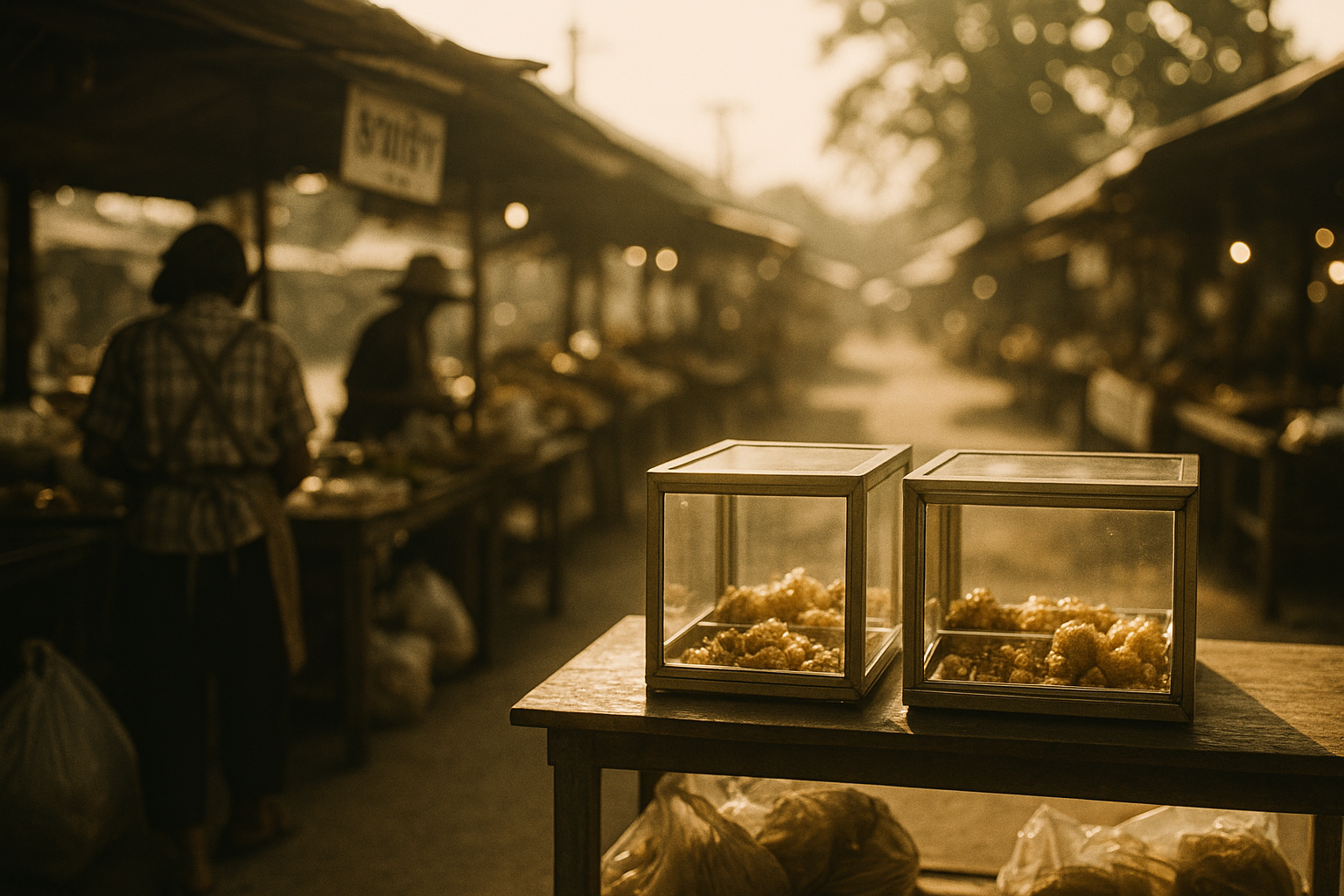
A kru (กรุ) is a sealed cache of amulets deposited inside a Thai Buddhist temple structure during construction or during a moment of significant consecration, then closed and left untouched, sometimes for many centuries. The objects found inside these chambers when they are eventually opened are among the oldest surviving examples of Thai devotional material culture, and three of the five amulet types in the benjapakee (เบญจภาคี) canon trace their defining editions directly to kru discoveries at major temple sites. To understand what a kru amulet is and why it carries the weight it does is to understand something essential about the relationship between Thai Buddhism and the physical object.
What Is a Kru?
The word kru refers to the chamber itself: the sealed space inside a chedi (เจดีย์), prang (ปรางค์), pillar, or wall into which amulets, votive tablets, relics, sacred texts, and other devotional objects were placed during the construction of a significant Buddhist structure. The physical reality is a masonry or laterite cavity, sometimes no larger than a wooden box, sealed with lime plaster or brick so that nothing visible from the outside marks its presence. Inside, the objects were sometimes arranged with deliberate care, sometimes packed in quantity.
The act of depositing these objects was itself a ritual one. Building a major chedi or prang was a meritorious undertaking of the highest order in Theravada Buddhist society, and embedding consecrated objects in the structure was understood as charging the building permanently with their spiritual quality. The sealed chamber was not a hiding place; it was a deliberate installation. The people who placed these objects inside did not expect them to be found. They were performing an act of faith directed toward an indefinite future, contributing to the merit of the sacred site for generations who would have no knowledge of what lay inside.
Kru are discovered in several ways. The most common is structural renovation: when aging temple infrastructure requires repair or rebuilding, the process opens walls and chedi cores that have been sealed for centuries, and the contents, if any, come to light. Earthquake damage has exposed kru at several sites. Deliberate unsealing, authorized by the temple administration and typically involving the Fine Arts Department of Thailand (กรมศิลปากร), has occurred in cases where deteriorating structures put the contents at risk.
The ethics of deliberate unsealing are genuinely debated within both the Thai heritage scholarship community and the amulet world. Some scholars and temple administrators hold that the objects were sealed in a consecrated act and that opening the chamber, whatever the reason, breaks a spiritual seal that should be respected permanently. Others argue that objects left inside deteriorating structures face permanent loss, and that careful supervised opening preserves what is otherwise certain to be destroyed. The Fine Arts Department holds legal jurisdiction over antiquities of this category, and unauthorized excavation of a kru site constitutes a criminal offense under Thai law.
Not all objects that reach the market as kru amulets necessarily originate in sealed caches. The substantial market value of genuine kru material creates a powerful incentive for fraud, a problem addressed at length in the authentication section below.
Major Kru Sites
The five sites below represent the most historically significant kru discoveries in the Thai amulet tradition. Each produced amulets that now constitute canonical reference points in the collector record.
Wat Phra Si Rattana Mahathat, Phitsanulok
The chedi complex at Wat Phra Si Rattana Mahathat in Phitsanulok is the source of the Phra Nang Phaya (พระนางพญา), one of the benjapakee five and the only canonical amulet associated in tradition with a female royal patron. The Nang Phaya is a pressed-clay figure in a distinctly feminine seated posture, its identity linked in some temple accounts to a consort of the Ayutthaya period who contributed to the temple's construction. [VERIFY: specific discovery year and circumstances for the Phitsanulok cache against Fine Arts Department records] The Phitsanulok examples establish the iconographic standard against which later Nang Phaya editions are measured in the collector community.
Wat Mahawan, Lamphun
Lamphun, the former center of the Haripunchai kingdom that predates the Thai states of Sukhothai and Ayutthaya, produced some of the oldest confirmed pressed-clay amulets in the tradition. The Phra Rod (พระรอด), another benjapakee member, originates from caches at Wat Mahawan and related Haripunchai-period structures. Some Phra Rod examples are attributed to the Mon artistic tradition that characterized Haripunchai and show iconographic elements that distinguish them clearly from later central Thai production, including distinctive robe treatment and base proportions. [VERIFY: specific dating of Haripunchai-period kru at Lamphun against Fine Arts Department archaeological reports and Phra Rod reference literature]
Wat Ratchaburana, Ayutthaya
The opening of the main prang at Wat Ratchaburana in Ayutthaya in 2500 BE (1957 CE) is one of the most thoroughly documented kru events in the Thai historical record. Workers carrying out renovation discovered a chamber containing gold objects, royal regalia fragments, votive tablets, and amulets, all of them consistent with the Ayutthaya royal period. The scope was exceptional by any standard in Thai amulet history. Many objects from this cache are now held by the Chao Sam Phraya National Museum in Ayutthaya; others entered circulation through channels that were not always fully controlled by the Fine Arts Department in the period immediately following the discovery. The Ratchaburana cache remains the benchmark event in Thai scholarship on royal-period kru material and its provenance.
Wat Phra Si Rattana Mahathat, Suphanburi
The Phra Phong Suphan (พระผงสุพรรณ), the third benjapakee member that traces to a kru source, originates from deposits at this Suphanburi temple. The objects are made from a fine mudstone or clay compound specific to the Suphanburi area, and the iconography shows Ayutthaya-period stylistic characteristics consistent with the temple's construction history. The Suphanburi material has its own range of phim (พิมพ์) types with well-documented iconographic standards. [VERIFY: specific kru discovery record for Suphanburi and whether the original cache opening was documented by the Fine Arts Department]
Wat Kamphaeng Laeng, Phetchaburi
Wat Kamphaeng Laeng, a Khmer-period structure that was subsequently absorbed into the Theravada Buddhist tradition during the Thai period, has produced kru material that documents the transition between Khmer and Thai Buddhist iconographic conventions at a single site. The mixed nature of the finds, reflecting elements of both traditions, makes this site particularly valuable to scholars of religious art history working on the period when Khmer temple complexes in the Thai territory were converted to Theravada use.
What Kru Amulets Tell Scholars
Kru material is exceptionally valuable to scholars of Thai religious history precisely because of its provenance certainty. An object found sealed inside a structure built in a known historical period cannot have been produced after that period. This sounds obvious, but it is in fact a rare quality. Most historical Thai votive objects have been in continuous circulation long enough that their original context is completely lost. A genuine kru amulet, if its provenance is verifiable, carries a date encoded in the building itself.
What this evidence reveals about the history of the tradition: the iconographic conventions of pressed-clay amulets were more consistent across regions in early periods than the later regional diversity would suggest. As the tradition matured, distinct regional schools developed sharply differentiated styles that are now identifiable as markers of origin. The Lamphun style differs from the central Thai style, which differs from the northeastern style, in ways that are readable in the phim geometry, the clay body composition, and the surface treatment.
The material composition of kru amulets, the clay bodies and powder mixtures used in different areas, can in principle be analyzed using portable XRF (X-ray fluorescence) spectrometry and thermoluminescence dating, methods that have been applied in research contexts. These scientific approaches remain rare in Thai authentication practice, however, and their results are not yet a standard part of the market certification system. The gap between laboratory capability and market practice is partly a matter of infrastructure, partly one of the tradition's own standards for what counts as evidence.
Kru material also documents the devotional priorities of different periods through what was chosen for inclusion. The Wat Ratchaburana cache reflects the resources and iconographic priorities of an Ayutthaya royal court: high-craft objects, royal iconography, materials that required substantial investment to produce. The Haripunchai-period caches at Lamphun reflect a different patronage environment, visible in the choice of forms and the material quality of the pressed-clay work. Together, the kru record across sites is a material history of Thai Buddhist devotional practice across a period of roughly eight centuries.
A specific challenge in working with kru material is the phenomenon of re-sealed caches: chambers that have been opened, stripped of their genuine contents, restocked with copies of the original type, and resealed to make the fraudulent objects appear to carry legitimate kru provenance. Identifying a re-sealed cache requires both physical evidence, including mortar analysis and disturbance patterns in the sealing material, and consistency checks between the reported contents and documented iconographic and material standards for that site. This is a documented problem in the Thai authentication community and is part of why provenance chain matters as much as the object itself.
Authentication and the Kru Problem
The market value of accepted kru amulets at the highest level of the collector world is substantial. Certified examples of Phra Rod from the Haripunchai period, Phra Nang Phaya from the Phitsanulok cache, and Phra Phong Suphan from Suphanburi trade at prices that range from the tens of thousands to the millions of baht (thousands to hundreds of thousands of USD, as of Aug 2026), with authentication resting on the Thai amulet association circuit rather than scientific analysis as a primary mechanism.
This level of value creates a strong and longstanding incentive for the production of period-consistent copies. Counterfeiting is not a recent development in the kru market; it has been documented as long as the collector market has existed. The production of sophisticated copies is technically demanding: clay body composition can be mimicked using area-appropriate materials, surface aging effects can be induced through chemical and physical processes, and iconographic details can be reproduced with considerable accuracy using the same photographic references that legitimate collectors use for authentication.
What experienced authentication examiners look for in kru material is not any single indicator but the accumulated weight of multiple simultaneous characteristics:
- Surface crystallization patterns consistent with the natural aging of lime and mineral compounds over century-scale periods, not achievable through artificial aging techniques currently documented.
- Iconographic geometry that matches the established phim standards for the specific site and period in question, assessed against the published photographic record.
- Clay body composition using materials that are area-specific and period-consistent, where this can be assessed.
- Wear patterns consistent with legitimate long-term storage and, in some pieces, handling and use over extended periods.
- The absence of the specific artifacts of artificial aging, including chemical residues, anomalous surface textures, and inconsistencies in the aging pattern across different surfaces of the same object.
The Thai amulet competition system operates as the practical mechanism through which this assessment is institutionalized. Objects submitted to recognized association panels are examined by multiple experts whose collective judgment is what grants or withholds certification. An accepted piece carries dated committee documentation; an unsubmitted piece carries market uncertainty regardless of its actual character. At the top of the kru market, the gap between certified and uncertified is the entire price difference.
Collecting Kru Amulets
Kru amulets change hands through chao (เช่า), the rental convention, like all phra khrueang: the cultural understanding is that the sacred object enters a custodial relationship rather than simple ownership, and this applies to objects of any age or value. At the market level, this convention coexists with a sophisticated system of pricing, certification, and commercial exchange that participants engage in full awareness of both its religious and its economic dimensions.
The primary national venues for kru material of all grades are the amulet market district near Tha Phra Chan and Wat Mahathat along the Chao Phraya in Bangkok, and the regional markets in the provinces where significant kru sites are located. The Bangkok market draws sian phra (เซียนพระ), specialist collectors, from across the country and from the Thai diaspora, and it is where the best-documented examples of kru material at the high end tend to surface and change hands.
The appeal of kru material to collectors goes beyond price or prestige, though both are real factors. A kru amulet is a devotional object made, consecrated, and sealed away by people who were performing an act of faith with no expectation of return. It has spent centuries inside the structure of a sacred building, in the darkness of a chamber that was meant to remain closed. The age is not incidental to the object; it is part of what the object is. The crystallized clay body, the sealed surface, the accumulation of mineral time: these are the object's biography, and they are visible to anyone who holds it.
Thai amulet magazines, particularly the peer-reviewed publications of the major amulet associations, provide the primary reference photographic records for kru material from named sites. These publications, produced in Thai, are the essential reference tools for any collector working seriously with genuine kru amulets, and their acceptance standards are what market pricing reflects.
The Objects That Waited
What the kru tradition documents, across all the variation of site and period and iconographic school, is the depth of Thai Buddhist devotional culture's commitment to the physical object as a carrier of meaning that outlasts the individual. The people who sealed these chambers were not hiding objects. They were installing them in a future they could not see, contributing to a sacred space through an act of faith whose return they did not expect to collect.
The objects eventually emerged: through renovation, damage, or deliberate opening, into a world that had changed around them in every way except the essential one. The tradition that made sense of them when they were placed inside the walls is the same tradition that makes sense of them now, carried in pockets and worn around necks in a country that has built ten thousand more temples in the centuries since. A kru amulet is not an antique in the usual sense. It is an active participant in a practice that never stopped.