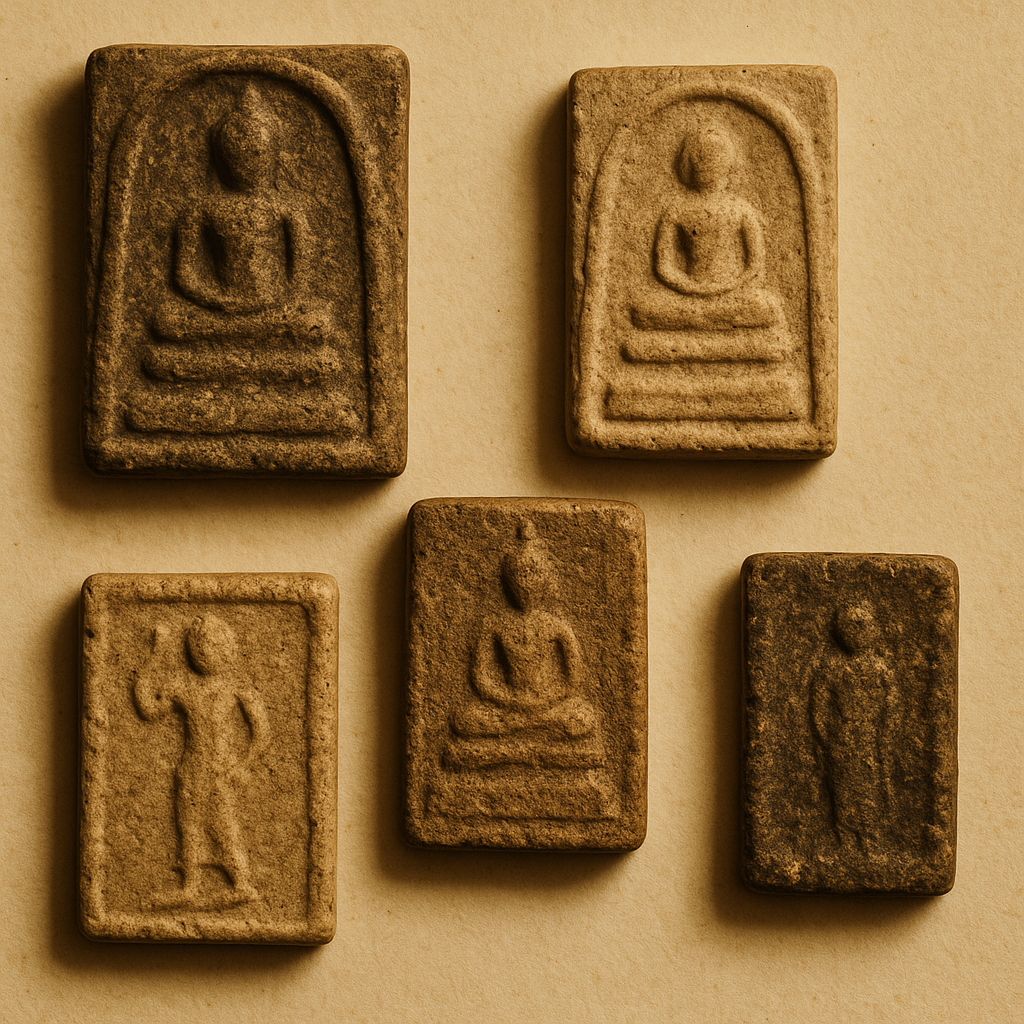
Benjapakee (บัญจภาคี) names the five canonical antique amulet types that anchor Thai amulet scholarship and define the collector canon. The word combines benja, from the Pali and Sanskrit for five, and pakee, denoting membership in a defined group. The five are: Phra Somdej of Wat Rakhang Khositaram (Bangkok), Nang Phaya (Phitsanulok), Phra Rod of Wat Mahawan (Lamphun), Phra Phong Suphan (Suphanburi), and Phra Sum Kor (Kamphaeng Phet). All are antique pressed-clay types. Together they constitute the foundation of serious connoisseurship in the Thai amulet world. In the renting convention standard in Thai amulet culture, chao (เช่า), original examples from these series are among the most significant objects a devotee or collector can hold in custody.
Phra Somdej
Phra somdej (พระสมเด็จ) is the most studied type in the Thai amulet canon. Its standard form is a pressed tablet depicting a seated Buddha figure in the bhumisparsa mudra, the earth-touching posture, set within a tiered arch frame known as the prasat. The tablet is typically rectangular with a slightly domed front face and a flat or lightly textured reverse.
The type is historically associated with Somdej Phra Phutthachan Toh Phrommaransi, the abbot of Wat Rakhang Khositaram on the Bangkok bank of the Chao Phraya River. He is the most revered monk of the Rattanakosin period, and the tradition holds that he produced the defining series of phra somdej tablets in the BE 2400s, roughly corresponding to the 1860s CE. Documentation of his life and practice is extensive by the standards of Thai monastic biography, and his association with the tablets has been the subject of serious Thai-language scholarship.
The material composition of Wat Rakhang phra somdej tablets is a subject of sustained collector inquiry. The tradition holds that Somdej Toh prepared his mixture from chalk powder, sacred herb powder, pollen from the flowers used in temple offerings, rice powder, ground fragments of earlier consecrated objects, and materials associated with specific sacred sites. The resulting nuea phong, the powder body, is characteristically pale and fine-grained with a surface that shows specific patterns of aging over time.
Collectors distinguish dozens of named phim (พิมพ์), mold types, within the Wat Rakhang series. Each phim is identified by specific proportions of the figure relative to the frame, the number and angle of the arch tiers, the rendering of the lotus throne, and other visible details. The most recognized phim include phim yai (large mold), phim kanan (medium mold), phim lek (small mold), phim thaan saem (shallow base mold), and several further subdivisions of each. Identifying which phim a tablet belongs to is the first step in examining any phra somdej seriously.
Surface condition is the second major criterion. Old phra somdej tablets from the Wat Rakhang series show specific patterns of surface crazing, micro-crack formation, and organic staining that are consistent with their age and storage history. These patterns are difficult to replicate exactly and are among the indicators collectors use in assessment. Beyond Wat Rakhang, phra somdej tablets were produced at other Bangkok temples during and after Somdej Toh's lifetime, including Wat Bowonniwet and Wat Bang Khunphrom, and distinguishing between series requires attention to material and mold differences.
Nang Phaya
Nang Phaya, meaning Queen or Royal Lady, is one of the most debated types in the benjapakee. The tablets are associated with Wat Nang Phaya in Phitsanulok, in the lower northern region of Thailand, and are generally dated to the Sukhothai period, placing them somewhere in the range of 20th to 22nd century BE (late 14th to early 16th century CE), though the precise dates remain a matter of scholarly discussion.
The name connects the tablets to a tradition associating their production with the patronage of a queen or high-ranking woman. The hagiographic account, as preserved in the collector and temple tradition, holds that the tablets were made under royal female patronage as an act of merit-making during a period of the temple's significance. Documented historical evidence for the specific circumstances of production is limited, and this is an area where the tradition's account and the historical record diverge in ways that specialists acknowledge.
The form is distinctive. Nang Phaya tablets are typically oval or arched at the top, depicting a seated Buddha figure in a setting that varies by phim. The body is made from clay with a composition that produces a characteristic red-tinted or cream-tinted surface, depending on the specific phim variant. The red-body (nuea daeng) examples are particularly noted. Some tablets show traces of gilding on the surface, applied at the time of production or in subsequent devotional practice.
The most recognized phim of the Nang Phaya type include phim sanam (field mold), identified by a wide, open composition, and phim bua toom (lotus bud mold), identified by a tighter figure and more defined arch. Surface condition in genuine antique examples shows specific patterns of clay aging, surface erosion at high points, and in some cases mineral accretion consistent with long burial in the temple cache.
Wat Nang Phaya remains an active temple in Phitsanulok, and its association with this amulet type gives it a place in the Thai amulet world disproportionate to its size. The tablets recovered from its kru (กรุ), the temple cache, have been the subject of sustained collector attention since their discovery and distribution in the 20th century BE 24 period (early to mid 20th century CE).
Phra Rod
Phra Rod is associated with Wat Mahawan in Lamphun, a city in northern Thailand that preserves some of the oldest Buddhist institutional history in the region. The tablets are among the oldest confirmed pressed-clay amulets in the Thai collection tradition, with some scholarly assessments placing their production in the 14th to 16th century BE range, corresponding to the 9th to 11th century CE, in the period of the Haripunjaya kingdom that preceded Lanna rule of the region.
Physical testing has been applied to Phra Rod tablets in a small number of cases. Thermoluminescence dating, which measures accumulated radiation in ceramic material to estimate the time since last firing, has produced results consistent with high antiquity for some examples. These tests are imperfect and contested as evidence, but they constitute the clearest scientific engagement with the age claims for any benjamin type.
The form of Phra Rod tablets is varied. The figure is typically depicted standing or in a striding posture rather than seated, which distinguishes the type visually from phra somdej and nang phaya. The name rod may refer to a formal designation or may be a colloquial term whose origin is debated. The material is typically a dark clay body with a surface texture distinct from the chalk-powder compositions of Bangkok-period tablets.
Multiple phim are recognized within the Phra Rod category, varying in the posture and proportion of the central figure, the treatment of the base or plinth, and the presence or absence of a surrounding arch or frame. The most studied examples come from the Wat Mahawan kru, and the distribution history of those tablets is part of the documented record that specialists use to assess examples.
The age of Phra Rod, if the assessments hold, would make them genuine artifacts of early mainland Southeast Asian Buddhism rather than later ritual productions. This archaeological dimension gives them a significance distinct from the other benjapakee types, most of which date to the Ayutthaya or Rattanakosin periods.
Phra Phong Suphan
Phra Phong Suphan is associated with Suphanburi province in the central region of Thailand. The tablets are typically dated to the Ayutthaya period, placing production somewhere in the range of 19th to 23rd century BE (14th to 18th century CE), though as with other benjapakee types the specific dating is subject to ongoing discussion.
The name associates the tablets with Suphanburi, a city with a long history of regional significance in central Thailand, and with phong, meaning powder, referencing the material composition. The tablets are characteristically made from a pale, fine powder clay body, often described as having an almost white or cream surface. This distinguishes them from the darker clay bodies of northern types like Phra Rod.
The type overlaps in collector discussion with the Khunpaen amulet, a type strongly associated with Suphanburi and with the legendary warrior figure of Khun Paen from the Thai literary epic. The distinction between Phra Phong Suphan as a benjapakee type and the broader category of Suphanburi amulets that carry the Khunpaen association requires attention to form, material, and documented provenance. Not all pale-clay Suphanburi tablets qualify as benjapakee Phra Phong Suphan examples, and the collector literature addresses this distinction at length.
The form varies by phim, with examples ranging from seated figures in arch frames to simpler presentations. The surface of genuine antique examples shows aging patterns consistent with central Thai clay compositions and burial history. The regional significance of Suphanburi in the central Thai cultural landscape gives these tablets a particular resonance beyond their status as collector objects.
Phra Sum Kor
Phra Sum Kor is associated with Kamphaeng Phet province in lower northern Thailand. The name sum kor refers to the characteristic form of the type: three arch pillars or columns in the background of the composition, giving the tablet a distinctive visual signature that sets it apart from the other benjapakee types. Sum means three and kor denotes the pillar or column element.
The tablets are associated with the archaeological sites of Kamphaeng Phet, which include significant Sukhothai-period temple remains. The region was an important center of Thai Buddhism during the Sukhothai kingdom, and the tablets are generally dated to that period or to the early Ayutthaya period, placing production in the range of 19th to 21st century BE (14th to 16th century CE).
The three-pillar or three-arch composition is the primary identifying visual feature. The central figure, typically a seated Buddha, is framed by this distinctive triple structure, which may represent three pillars of the temple hall, three arches in a gateway, or a formalized architectural frame with specific symbolic meaning. Collectors look for the proportion and spacing of the three elements as a primary phim identifier.
The material composition is a clay body consistent with the central-northern Thai region, with surface characteristics that specialist collectors distinguish from the other benjapakee types. Archaeological context is relevant here: tablets recovered from documented kru at Kamphaeng Phet sites have a traceable provenance that supports their identification, while examples of unclear origin require closer material analysis.
For the serious collector, Phra Sum Kor represents the northwestern anchor of the benjapakee geographic spread, completing a set that runs from Bangkok in the south through the central region (Suphanburi) and lower north (Phitsanulok, Kamphaeng Phet) to the far north (Lamphun). The geographic spread of the five types is itself understood as part of what gives the benjapakee its canonical status: it represents the major regional traditions of Thai Buddhism in a single framework.