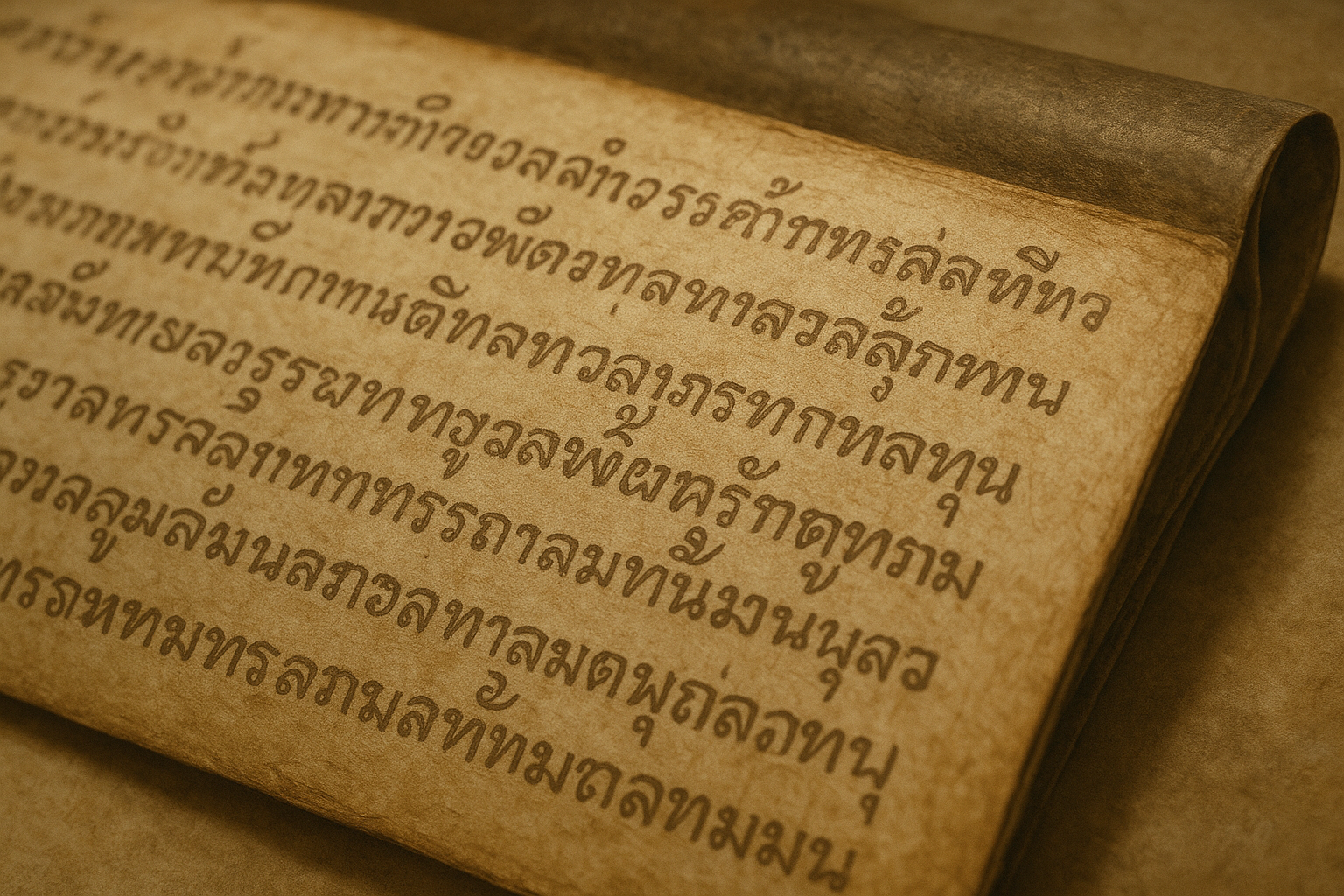
The vocabulary of phra khrueang (พระเครื่อง) moves between Pali, Sanskrit, Central Thai, and regional dialects. These entries define the terms that appear most often in serious discussion of the tradition. Each entry includes a usage example and links to related terms within the glossary.
Jump to: Phra khrueang · Chao · Pluksek · Phutthaphisek · Katha · Yant · Sak yant · Takrut · Phim · Nuea · Muan sarn · Kru · Rian · Phra somdej · Phra pidta · Benjapakee · Bucha · Sian phra · Wai khru · Wat
- Phra khrueang (พระเครื่อง) /phrá krɯang/
-
Phra khrueang denotes Thai Buddhist amulets as a class: small consecrated objects, typically worn on the body or kept in a place of devotion. The category encompasses pressed clay tablets, metal medallions, rolled metal scrolls, and figurines. Each object has passed through a consecration rite conducted by monks. Devotees hold that wearing or keeping a phra khrueang maintains a connection to a specific teaching lineage or sacred person.
Usage: A collector studying the benjapakee must become familiar with the full range of phra khrueang types before focusing on the antique canon.
- Chao (เช่า) /chao/ (rhymes with "cow")
-
In the Thai amulet world, objects change hands through a convention called chao, meaning to rent. The devotee does not acquire an amulet outright; they enter a custodial arrangement, taking temporary stewardship of an object whose sacred identity is understood to belong to the temple or lineage that produced it. This framing distinguishes the transaction from commercial sale and aligns it with devotional logic rather than ownership.
Usage: When a devotee approaches a temple counter to chao an amulet, the exchange is understood as entering a relationship with the lineage, not acquiring property.
- Pluksek (ปลุกเสก) /plùk sèk/
-
Pluksek denotes the act of consecrating a sacred object. The word combines elements meaning "to awaken" and "to sprinkle with sacred water." During pluksek, monks chant katha, meditate, and direct concentrated attention toward the objects being consecrated. The tradition holds that the practice transfers the monk's accumulated merit and the potency of the chanted verses into the object. Pluksek may be performed by a single monk or a large assembly.
Usage: Senior monks sat in meditation through the night as the pluksek proceeded, the assembled katha filling the ordination hall until dawn.
- Phutthaphisek (พุทธาภิเษก) /phút-thā-phí-sèk/
-
Phutthaphisek denotes a large-scale formal Buddhist consecration ceremony. Where pluksek may refer to any act of consecrating a sacred object, phutthaphisek implies a structured ceremonial event involving multiple senior monks, extended chanting sequences, and ritual preparations following established temple protocol. Major amulet series are consecrated through phutthaphisek events that can draw hundreds of monks and thousands of devotees. The ceremony is often documented by temple media and amulet association publications.
Usage: The documentary record of the phutthaphisek held at Wat Rakhang in BE 2515 (CE 1972) remains one of the most cited sources in the scholarship on that series.
- Katha (คาถา) /kā-thā/
-
Katha are sacred verses, drawn primarily from Pali and sometimes incorporating Sanskrit, Khmer, or Thai elements. They are chanted during consecration ceremonies, daily devotional practice, and ritual contexts including the application of sacred tattoos. Specific katha are associated with particular amulet types, lineages, and protective intentions. The tradition teaches that correct recitation activates the relationship between the devotee and the sacred object or quality the verse addresses.
Usage: The Itipiso katha, enumerating the nine virtues of the Buddha, is chanted at phutthaphisek ceremonies throughout Thailand and is the source of the name Lokavidu.
- Yant (ยันต์) /yan/
-
Yant are sacred geometric diagrams incorporating Khmer and Pali script, sacred numerals, and symbolic forms. The word derives from the Sanskrit yantra. Yant appear inscribed on amulets, pressed into clay tablets, inked onto cloth, tattooed onto skin, and painted on temple walls and vehicles. Each configuration encodes specific protective or auspicious intentions. The tradition holds that a correctly inscribed and consecrated yant carries the force of the katha embedded within its design.
Usage: The reverse of the takrut carries a yant whose configuration identifies it as belonging to the Khao Or school of southern Thailand.
- Sak yant (สักยันต์) /sàk yan/
-
Sak yant are sacred tattoos: yant diagrams applied to the skin by a monk or recognized ritual specialist, known as an ajarn (อาจารย์), meaning teacher or master. The application uses a long needle or sharpened rod and is accompanied by chanting. Devotees hold that a properly applied sak yant provides protection, virtue, and the specific qualities associated with the design. The practice is governed by lineage conventions and carries ongoing obligations on the part of the recipient.
Usage: The ajarn inscribed the sak yant with the same katha his own teacher had used, maintaining the lineage transmission intact.
- Takrut (ตะกรุด) /tā-krùt/
-
A takrut is a thin sheet of metal, typically lead, tin, copper, silver, or gold, inscribed with yant and katha and then rolled tightly into a cylindrical form. Takrut are among the oldest forms of Thai sacred object. They are worn on a cord around the waist, neck, or arm, or enclosed within larger amulet casings. The material chosen for the sheet and the inscribed content are both considered part of the object's sacred identity.
Usage: The monk inscribed a long takrut on a sheet of lead, rolling it tightly before tying the cord that would suspend it from the devotee's waist.
- Phim (พิมพ์) /phim/
-
Phim denotes the mold or press type that defines an amulet's form. For pressed clay tablets such as phra somdej or the benjapakee types, the phim identifies which template was used and, by extension, which batch, production period, or series an amulet belongs to. Distinguishing phim is central to authentication and connoisseurship. A single amulet type may exist in dozens of named phim variants, each with distinct proportions, depth of relief, and provenance.
Usage: Establishing which phim a phra somdej belongs to is the first step in any serious examination of the object.
- Nuea (เนื้อ) /nɯa/ (rhymes with "newer")
-
Nuea, meaning flesh in standard Thai, refers in the amulet context to an object's material composition. The term describes the specific mixture from which an amulet is formed: a chalk and herb powder (nuea phong), a metal alloy (nuea loha), or other composite materials. Nuea is one of the primary criteria collectors use to distinguish between versions of the same design. The composition affects surface texture, color, weight, and the nature of the muan sarn incorporated.
Usage: Two phra somdej from the same phim can be distinguished by their nuea: one presses chalky and pale, the other is darker and denser from the proportion of herb powder used.
- Muan sarn (มวลสาร) /muan sǎn/
-
Muan sarn are the sacred substances incorporated into an amulet's material composition. The term refers collectively to ritual ingredients such as powdered relics, soil collected from sacred sites, pollen, medicinal herbs, fragments of older consecrated objects, and materials associated with the presiding monk's lineage. The selection and preparation of muan sarn is considered a significant dimension of the amulet-making process. Collectors study the muan sarn of notable series as both a scholarly and devotional engagement.
Usage: The muan sarn of that series included soil gathered from 108 chedis across Thailand, a detail documented in the temple's printed account of the ceremony.
- Kru (กรุ) /kroo/
-
A kru is a sealed chamber or niche, typically within a temple structure such as a stupa or ordination hall, in which amulets were deposited for long-term preservation. The discovery of a kru, sometimes described as opening the kru, yields objects of documented archaeological provenance. Kru amulets are among the most prized in the collector world because their origin is verifiable and their age is unambiguous. All five benjapakee types are kru or temple-cache discoveries.
Usage: When the kru of Wat Nang Phaya was opened, the tablets recovered established a reference set that scholars have used to authenticate the type ever since.
- Rian (เหรียญ) /ree-an/
-
A rian is a coin-shaped or medallion-form amulet, struck or cast in metal. The face typically depicts a revered monk, a Buddha image, or a sacred motif; the reverse often carries a yant or katha inscription. Rian have been produced since at least the late Rattanakosin period and constitute one of the largest categories in the collector market. Major monk rian, particularly those associated with well-documented consecration events, are carefully catalogued by collectors' associations.
Usage: The rian issued for Luang Phor Tim's birthday in BE 2518 (CE 1975) remains one of the most studied medallion types in the southern Thai tradition.
- Phra somdej (พระสมเด็จ) /phrá sǒm-dèt/
-
Phra somdej is the most studied type in the Thai amulet canon. The standard form is a pressed tablet depicting a seated Buddha figure within a tiered arch frame, made from a chalk and sacred powder composition. The type is historically associated with Somdej Phra Phutthachan Toh Phrommaransi of Wat Rakhang Khositaram in Bangkok, who is credited with producing the defining series in the BE 2400s (mid-19th century CE). Collectors recognize dozens of distinct phim variants.
Usage: Establishing that a phra somdej belongs to the Wat Rakhang series requires examination of the phim, the nuea, and the surface condition consistent with objects of that age.
- Phra pidta (พระปิดตา) /phrá pìt-tā/
-
Phra pidta depicts a seated figure with hands, and sometimes multiple arms, covering the eyes and other sensory openings. The name means "closed eyes" or "closed gates." The image is associated in the tradition with the closing of the sensory pathways as a meditative posture, and is connected to the figure of Phra Sangkajai (Kaccayana), a revered disciple of the Buddha noted for his teachings on contentment. Devotees hold phra pidta associated with protection and material fortune.
Usage: The phra pidta from that southern lineage is distinguished by its multiple arms, each set of hands sealing a different sensory gate, a configuration rarely seen outside the Khao Or school.
- Benjapakee (บัญจภาคี) /ben-jā-pā-kee/
-
Benjapakee names the five canonical antique amulet types considered foundational to Thai amulet scholarship and collecting. Benja derives from the Pali and Sanskrit for five; pakee denotes membership in a defined group. The five are: Phra Somdej of Wat Rakhang Khositaram (Bangkok), Nang Phaya (Phitsanulok), Phra Rod of Wat Mahawan (Lamphun), Phra Phong Suphan (Suphanburi), and Phra Sum Kor (Kamphaeng Phet). All are antique pressed clay types. The canon anchors serious connoisseurship.
Usage: Collectors who specialize in the benjapakee dedicate years to studying the phim variants, nuea characteristics, and kru provenance of each of the five types.
- Bucha (บูชา) /boo-chā/
-
A bucha image is a sacred figure intended for display at a home shrine or altar rather than for wearing on the body. The word derives from the Pali and Sanskrit puja, meaning veneration or offering. Bucha images are typically larger than wearable amulets and are kept in a place of honor, with offerings of flowers, incense, or water placed before them. The devotional relationship to a bucha image is maintained through daily or regular ritual attention.
Usage: The temple produced a limited bucha image of the abbot to accompany the amulet series, intended for home shrines of devotees who had made significant merit offerings.
- Sian phra (เซียนพระ) /see-an phrá/
-
Sian phra describes a serious amulet enthusiast or collector. Sian derives from a Chinese term for an enthusiast or devoted expert in a particular subject; phra refers to sacred objects. The sian phra community constitutes a distinct social world with its own specialist publications, collectors' associations, authentication practices, and vocabulary. Levels of knowledge and reputation within the community range from casual participants to recognized experts whose assessments carry weight in questions of attribution and provenance.
Usage: The sian phra community spent years debating the provenance of that kru find before reaching a working consensus, a process documented in the major amulet magazines of the period.
- Wai khru (ไหว้ครู) /wai khroo/
-
Wai khru is a ceremony of respect for teachers and lineage. Wai refers to the Thai gesture of reverence, pressing the palms together; khru is the Thai form of the Sanskrit guru, meaning teacher. Wai khru ceremonies are observed in many Thai contexts, from schools to martial arts studios to sacred tattoo lineages. In the amulet world, wai khru marks the ritual acknowledgment of the transmission of knowledge and sacred practice from teacher to student across generations.
Usage: The ajarn opened the annual wai khru by leading students in the katha of his lineage, the same verses his own teacher had recited at the ceremony three decades before.
- Wat (วัด) /wát/
-
A wat is a Thai Buddhist temple: the institutional center of Thai Buddhist life. Each wat comprises a monastic community, an ordination hall, and associated structures including chedis (stupas), pavilions, and shrine rooms. Amulet production, consecration ceremonies, and the preservation of sacred objects are all temple-based activities. The identity of an amulet is inseparable from the wat associated with its production, and the reputation of the presiding monks determines much of its devotional significance.
Usage: The prestige of the phra somdej series rests in part on the historical standing of Wat Rakhang Khositaram as one of the senior temples of Bangkok.