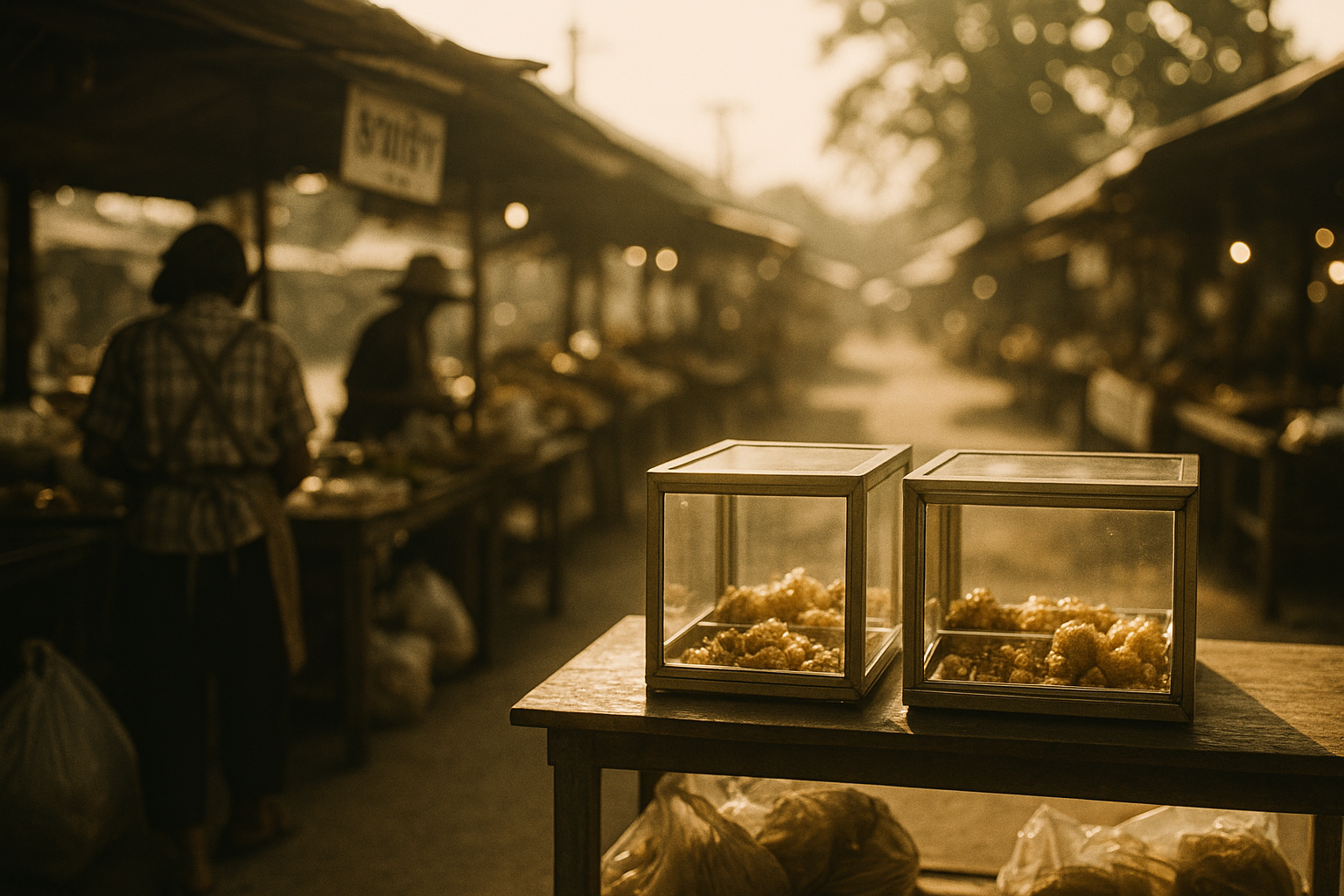
Khao Or (เขาอ้อ) is a limestone karst formation in Phatthalung province, southern Thailand, that has served for centuries as the principal site of an esoteric knowledge tradition: wicha (วิชา), a body of sacred practice and technical knowledge transmitted directly from master to student, that stands distinctly apart from the institutional Bangkok-centered amulet world in its methods, its aesthetics, and its understanding of what a sacred object is. The amulets and objects produced within the Khao Or lineage are among the most technically demanding in Thai practice, valued by collectors for a quality of transmitted authority that no institutional ceremony of any scale can replicate. For anyone trying to understand southern Thai amulets, the Khao Or tradition is the starting point.
The Sacred Hill
Phatthalung province occupies a narrow corridor between the mountains of the Thai-Malay peninsula to the west and the brackish Songkhla Lake to the east, a few hours north of Hat Yai by road. The Khao Or formation rises from this coastal plain: a limestone karst hill honeycombed with caves and natural chambers, draped with vegetation, and marked at multiple points with shrines, sacred images, and the material residue of generations of spiritual practice.
The caves of Khao Or have been used for meditation, ritual, and the storage and production of sacred objects for at least several centuries, and almost certainly longer. In Theravada Buddhist cosmology, as in the broader South and Southeast Asian sacred geography that pre-dates any particular religious system, specific landforms accumulate spiritual significance through their association with practice over time. A hill is not declared sacred by royal decree or temple committee; it becomes sacred because accomplished practitioners, across generations, recognized it as a place where conditions were right for practice and chose it. Khao Or's significance is the accumulated product of that choosing.
The tradition that developed at Khao Or draws on both Theravada Buddhist monastic practice and the older layer of Brahminic and animist knowledge that underlies much of southern Thai wicha. These two currents are integrated within the tradition rather than held in tension. The masters of Khao Or are typically ordained monks or former monks who also hold inherited wicha drawn from both Buddhist lineages and older regional knowledge systems. The combination produces objects with a character that is simultaneously Buddhist in its ritual framework and distinctively southern in its material and aesthetic logic.
The hill sits within easy reach of several towns in Phatthalung, and it draws devotees for both its cave shrines and its connection to the practitioners who have worked there. For collectors and scholars, it is one of the few sites where the physical landscape and the amulet tradition are still directly readable as a continuous whole.
What Makes Khao Or Different
Central Thai amulet production, as exemplified by the major Bangkok temples, operates within an institutional framework. Major phutthaphisek (พุทธาภิเษก) ceremonies involve dozens of senior monks in sustained all-night chanting over trays of amulets produced in substantial quantities. The prestige of a Bangkok edition rests on institutional markers: the seniority and recognized barami of the officiating monks, the scale of the ceremony, the age and standing of the issuing temple. The amulet carries the consecrated weight of the institution.
The Khao Or tradition works from different premises. Here, authority derives from transmitted wicha: the lineage of esoteric knowledge that passes from master to student through a process of direct instruction, extended supervised practice, and ritual authorization. An object's weight comes from the quality of the lineage that produced it, not primarily from the prestige of any institution. A Khao Or master who has received and fully practiced the curriculum can produce an object of recognized authority working alone, or in a small group, without the apparatus of a major ceremony. The ceremony is interior, not exterior.
This distinction shapes the objects at every level. Khao Or amulets tend to be produced in smaller runs, more individually made, more variable within a master's output, and more specific in their iconographic vocabulary than standardized Bangkok editions. The materials are characteristic of the southern tradition: particular herbs gathered from the Phatthalung hills, lead alloys prepared according to lineage formulas that include specific materials added at the smelting stage, palm-leaf yantra inscribed in Khom script, and ceramic or bone elements in some objects. The surface of a Khao Or lead piece looks and feels different from central Thai loha work because it is different, in both composition and intent.
The lersi (ฤๅษี), the hermit-sage figure drawn from Hindu-derived spiritual tradition, appears prominently in the Khao Or aesthetic alongside the Buddhist monk. Lersi images in amulets, in yant (ยันต์), and in ritual practice are characteristic markers of the southern wicha tradition and distinguish it visually and conceptually from the mainstream institutional world. The lersi is the practitioner of the older, pre-Buddhist layer of sacred knowledge that the Khao Or masters integrate into their practice, and his presence in the objects is a signal to knowledgeable viewers of the lineage the object belongs to.
Animal symbolism is prominent in Khao Or aesthetics in ways that further distinguish it from the purely anthropomorphic focus of Bangkok amulet production. Tiger images (suea, เสือ), crocodile images (chorakhe, จระเข้), and various animal yantra are characteristic marks of the southern tradition, drawing on a body of wicha in which animal forces are recognized as powers that a skilled practitioner can invoke and work with. These elements are absent from institutional Bangkok editions but central to the Khao Or object world, readable by anyone who knows the tradition.
Key Masters of the Khao Or Lineage
The lineage is defined in contemporary collecting by the major masters of the twentieth century, whose objects are the primary references for Khao Or work today. The lineage extends further back, but the earlier figures are less fully documented in accessible sources.
Phor Than Klai is the Khao Or tradition's most widely recognized figure of the modern era, and the monk whose objects are most actively collected by both Thai and international practitioners today. He was based at Wat Suan Khan in Nakhon Si Thammarat rather than in Phatthalung itself, a geographic distinction that reflects how the Khao Or lineage moved through practitioners who received the curriculum from Phatthalung masters and established their own practice further north in the south.
His characteristic objects include palm-leaf amulets in which the protective yantra was inscribed directly onto prepared palm leaf in Khom script, small lead-alloy figures produced by hand rather than by mold, and takrut (ตะกรุด) metal scrolls prepared according to lineage formulas. The palm-leaf pieces are the most distinctive formal contribution of his practice: a form closely associated with his name and with the Khao Or tradition's preference for direct inscription over pressed or cast mass production.
His barami accumulated over decades of practice at Wat Suan Khan made him the southern region's most widely cited exemplar of living wicha authority in his time, and his objects continue to trade at the top of the southern Thai amulet market. [VERIFY: dates of practice at Wat Suan Khan and date of death against temple records and Thai amulet association publications]
Among the most significant figures of the early twentieth century in the Khao Or tradition, Phor Than Jong is associated with the protective amulets and Nang Kwak (นางกวัก) images that characterized Khao Or production of his period. His objects are identifiable by a particular rendering style and by the material composition of his powder-based pieces. He represents the transmission of the pre-war Khao Or curriculum, and his amulets are the reference points for understanding how the lineage developed in the generation before it became nationally known.
[VERIFY: specific biographical dates, temple affiliation, primary editions, and lineage relationship to Phor Than Klai against Thai-language Khao Or reference literature]
The tradition places Luang Phor Thuad (หลวงพ่อทวด) as an ancestor figure to the Khao Or lineage, and several of the major Khao Or masters cite the deep south's LP Thuad tradition as a parallel or complementary current within the broader southern Thai wicha complex. Wat Chang Hai's devotional geography and the Khao Or hills are separated by approximately 200 kilometers, but the wicha tradition that connects them is understood by practitioners as a continuous regional field.
Objects produced by Khao Or masters specifically to honor LP Thuad exist as a documented sub-category of the lineage's output, carrying both the LP Thuad iconography familiar from Pattani editions and the material and inscriptive vocabulary specific to Khao Or practice. These pieces represent the intersection of two of southern Thailand's most significant sacred object traditions.
The Objects
Khao Or amulets are distinguished from central Thai amulets most immediately by their surface. The lead alloy used in many Khao Or objects is prepared according to lineage formulas that include specific materials added at the alloying stage, and the result is a characteristic dark, dense surface: not the bright reflection of pure lead or commercial pewter, but a matte, sometimes slightly textured face with a particular weight in the hand. This surface reads as materially distinct even at a distance, and experienced collectors recognize Khao Or lead work by its surface character before any other examination.
The objects come in several formal categories. Phong (powder) pieces are made from pressed powder compositions that include herbs specific to the Phatthalung hills, bone elements in some lineage formulas, and consecrated materials compounded according to the wicha curriculum. These are typically small, dense, and compressed by hand rather than machine-pressed: the compression marks are often visible on careful examination and are characteristic of the tradition. The surface carries the slightly granular quality of hand-pressed powder work rather than the smoother face of industrial pressing.
Lead figures and medallions are the second primary form. These are individually cast or hand-formed, and the variation within a single master's output reflects the handmade character of the work. The proportions and surface of an original Phor Than Klai lead piece, for instance, are not perfectly consistent across his production; the variation is itself an authentication indicator, since high-quality reproductions tend toward excessive consistency.
The reverse of Khao Or pieces carries inscriptions in Khom script (คาถา and yantra geometry) that are the most distinctive identifier of the lineage. The specific katha inscribed, and the yant geometry used, are lineage-specific: different masters within the Khao Or tradition use distinct inscriptive vocabularies inherited from their teachers, and a collector who knows the lineage literature can read the reverse of an object and identify the school if not always the individual master. The inscriptions are not decorative; they are the technical content of the object.
Ritual and Lineage Transmission
The Khao Or curriculum is transmitted from master to student through a process of direct instruction, ritual authorization, and extended supervised practice. The transmission is not simply the communication of technical information: the student must demonstrate through practice that the wicha has become operative, not merely memorized. A lineage object carries the consecrated status that comes from this chain of transmission; an object produced by someone who has received parts of the curriculum but not achieved the full practice is understood within the tradition as being of lesser depth.
This emphasis on transmission quality rather than institutional scale is what makes Khao Or objects different in kind from Bangkok temple editions. A Bangkok edition carries the consecration of the monks who performed the phutthaphisek. A Khao Or object carries the wicha of a specific practitioner in a specific lineage going back to specific teachers at a specific place. The two are not interchangeable devotional propositions.
The relationship between master and student in the Khao Or context involves obligations on both sides: the master is responsible for the integrity of the transmission and for assessing whether the student is ready to receive what comes next. The student is responsible for the standard of their practice and for the fidelity of what they eventually produce and pass on. An inadequate transmission or a failure of practice breaks the chain, and this is why lineage documentation matters to collectors of Khao Or material. They want to know not just which master made the object but where that master received the curriculum and from whom.
The animal symbolism in Khao Or aesthetics, particularly the tiger and the crocodile, reflects a body of wicha that understands the forces of the natural world as qualities that can be cultivated, recognized, and directed by a skilled practitioner. The tiger's power in this system is not metaphorical embellishment; it is a recognized force within the southern Thai cosmological framework, and the ability to work with it is part of what the Khao Or curriculum teaches. An LP Thuad figure made within the Khao Or tradition carries both the LP Thuad barami familiar from Pattani editions and the animal-wicha vocabulary of the Khao Or lineage, a combination that practitioners and collectors in the southern tradition regard as distinct from either tradition working alone.
Collecting Khao Or
Khao Or material changes hands through chao (เช่า), the rental convention, and reaches collectors through a combination of southern Thai regional markets, the Tha Phra Chan market district in Bangkok, and a community of sian phra (เซียนพระ), specialist collectors, who focus specifically on this tradition. The Bangkok market has the broadest selection and the most active price discovery; the southern regional markets, particularly in Phatthalung, Nakhon Si Thammarat, and Hat Yai, carry material that does not always reach Bangkok and that is better understood by buyers who know the local literature.
The objects most actively collected are the works of Phor Than Klai, particularly his palm-leaf pieces and his small lead figures, and the output of the senior Khao Or masters of the early and mid-twentieth century. Authentication is more complex here than in the Bangkok institutional world, because the small production runs and individually made character of Khao Or objects mean there is no single standard reference image. The variation within a master's output is wider than in a machine-pressed temple edition, which makes comparison-based authentication harder and demands deeper familiarity with the specific master's range.
The challenge for collectors working outside Thailand is access to the Thai-language reference literature. The major Khao Or masters are thoroughly documented in Thai amulet publications, with photographic reference records that allow material and iconographic comparison at a level of detail that general-audience resources do not approach. Engaging seriously with Khao Or collecting means engaging with that literature, either directly or through relationships with collectors who have.
The Khao Or tradition is one of the most significant and most under-documented areas of Thai amulet scholarship in English. The work of building that documentation, grounded in primary sources and direct material familiarity, is part of what this site intends to contribute.